|
The Prophet PBUH said, |
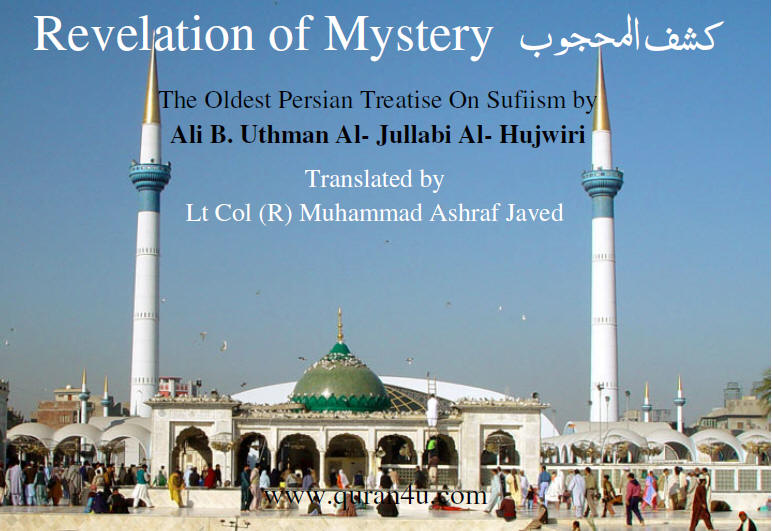
The Oldest Persian Treatise On Sufiism by Ali B. Uthman Al- Jullabi Al- Hujwiri Translated: Lt Col (R) Muhammad Ashraf Javed (Free Download) |
||||
|
Islam is based on (the following) five (principles): - To testify that none has the right to be worshipped but Allah and Muhammad is Allah's Apostle. - To offer the (compulsory congregational) prayers dutifully and perfectly. - To pay Zakat (i.e. obligatory charity) . - To perform Hajj. (i.e. Pilgrimage to Mecca) - To observe fast during the month of Ramadan. Narrated Ibn 'Umar: Bukhari |
|
Hadith Qudsi
Quick Links Online Quran Recitation - Ghamdi - Sudais - Shuraim - Ajmi Recitation With Translation - Pashto - François Quran Tafsir Video - Bayan al Quran Dr Asrar (Eng) - Sirat e Mustaqeem Dr G Murtaza Online Videos Online Talk shows - Religion & Human Intelligence Online Islamic Movies (English, Arabic, Urdu, French) - Moses Hadith
|
All Praises be to Allah, who hath revealed the secrets of His kingdom to His Auliya اولياء (Saints), and hath manifested the mysteries of His Almightiness to His intimates, and hath shed the blood of Lovers with the sword of His Glory, and hath let the hearts of Gnostics taste the joy of His union! He is Who bringeth dead hearts to life by the splendor of the perception of His Eternity and Majesty, and breathes them with the comforting spirit of Marifat معرفت (knowledge of Allah) by divulging His Names. And peace be upon His Prophet Muhammad, and his family and his companions and his wives!
Allah Almighty has said: وَعِبَادُ الرَّحْمَنِ الَّذِينَ يَمْشُونَ عَلَى الْأَرْضِ هَوْنًا وَإِذَا خَاطَبَهُمُ الْجَاهِلُونَ قَالُوا سَلَامًا “And the servants of (Allah) Most Gracious are those who walk on the earth in humility, and when the ignorant address them, they say, “peace!” (Q 25:63). And the Prophet (peace be upon him) has said: من سمع صوت اهل الَتَصوف فلا يومن علي دعاءهم كتَب عند اللَّه من الغافلين “He who hears the voice of the Sufis and does not say Amen to their prayer is inscribed before Allah among the heedless.” The true meaning of Tasawwuf تصوف (Sufism) has been much discussed and many books have been written on the subject. Some assert that Sufi is so called because he wears a woolen (suf صوف) garment, while others say that he is in the first row (saf صف). Some because of their attachment with to Ashab-i Suffa, call them Sufi and still some are of the opinion that the name is derived from safa (purity). These explanations are far from satisfying the requirements of etymology. The word Safa صفا (purity) is praiseworthy under all circumstances and its opposite is kadar كدر (impurity). The Prophet (peace be upon him) said, “ذهب صفو الدنياَ وبقي كدرها the pure part (the best) of this world is gone, and its impurity remains.” The fine and the delicate part of something is called safwa صفو (purity), whereas its impure and dirty part is called kadar (impurity). Since the seekers of the path of tasawwuf keep their morals and conduct pleasing and pure their inwards from the evils and worldly desires, on that account they are called Sufis. So, this name has become a sign of recognition whereas the nobility of the Sufis is too great for their dealings to be unknown, so that name should need a derivation.....
Translated By Lt Col (R) Muhammad Ashraf Javed “Maqam مُقام (station)“ denotes one’s stay in the Way of Allah, and his fulfillment of all rights and obligations pertaining to that "maqam“ and his keeping it until he comprehends its perfection. It is beyond man’s power to pass through a maqam without meeting its due obligations. There are following stations: - the first station is repentance, (tauba توبه) - the second station is conversion to Allah (inabat انابت), - the third station is abstinence (zuhd زهد), and - the fourth station is trust in Allah (tawakul توكل). It is not permissible that one should pretend to conversion without repentance, or to abstinence without conversion, or to trust in Allah without abstinence. وَمَا مِنَّا إِلَّا لَهُ مَقَامٌ مَّعْلُومٌ (Those ranged in ranks say): “Not one of us but has a place appointed;” (Q 37:164). "Hal حال (state)" is that state which descends from Allah into a man’s heart. It is not attainable by efforts neither it can be repelled with efforts when it happens. The term maqam (station) denotes, the way of the seeker of the Truth, progress in his diligence and efforts and acquisitioning of rank in the Court of Lord on the merit of one’s excellence and efforts. The term hal (state) denotes that favor and grace of Allah which descends on man’s heart without any mortification on his part..... .....where the friends of Allah because of the proximity of maqam (station) are in difficulty and danger, that is a maqam (station) of deliverance for all sinners, and where sinners are in difficulty and danger, there the infidels are fearless of their infidelity. Because, if infidels knew as sinners know, that their sins are displeasing to Allah, they would all be delivered from infidelity. Similarly if sinners knew, as the friends of Allah know, that all their actions are defective, they would all be saved from sins and purged of contamination. Therefore, outward and inward purification must go together.
|
|
© Copy Rights: Zahid Javed Rana, Abid Javed Rana Lahore, Pakistan |
Pages Viewed Since 21 Apr 2013
Web Counter |